
Can Skin Cancer Be Treated Successfully? Key Facts for Patients
Skin cancer is one of the most common forms of cancer worldwide, but it is also one of the most treatable when detected early. Advances in screening, surgical techniques, immunotherapy, and targeted treatments have significantly improved outcomes for many patients over the past two decades. While the word “cancer” understandably causes fear, the reality is that many skin cancers can be cured completely, especially when diagnosed before they spread.
The success of treatment depends on several factors, including the type of skin cancer, how early it is discovered, its location, and the patient’s overall health. Understanding these differences can help patients make informed decisions and recognize why early evaluation is so important.
Understanding the Main Types of Skin Cancer
Skin cancer is not a single disease. The three most common forms are basal cell carcinoma (BCC), squamous cell carcinoma (SCC), and melanoma.
Basal cell carcinoma is the most common type and generally the least aggressive. It usually develops slowly in areas frequently exposed to sunlight, such as the face, scalp, ears, and neck. BCC rarely spreads to distant organs, but it can grow deeper into surrounding tissue if ignored for long periods. Many cases are successfully treated with minor surgical procedures.
Squamous cell carcinoma is also common and often appears as rough, scaly patches or non-healing sores. SCC has a greater chance of spreading than basal cell carcinoma, particularly in people with weakened immune systems or untreated tumors. However, when detected early, cure rates remain very high.
Melanoma is less common but far more dangerous because it has a higher likelihood of spreading to lymph nodes, the lungs, liver, brain, or other organs. Melanoma develops in melanocytes, the pigment-producing cells of the skin. Despite its seriousness, survival rates for melanoma have improved dramatically because of earlier diagnosis and major advances in treatment.
Because treatment success depends heavily on timing, many patients seek rapid access to dermatology consultations, biopsies, and specialist evaluations when suspicious lesions appear. In some healthcare systems, waiting times for assessment can vary, which is one reason some individuals explore private skin cancer treatment options for faster diagnostics, second opinions, or access to specialized surgical and oncology services. Private care pathways may also provide more flexibility in appointment scheduling and continuity with the same specialist throughout treatment and follow-up.
There are also rarer forms, such as Merkel cell carcinoma, which can behave aggressively and require specialized treatment.
Early Detection Greatly Improves Outcomes
One of the most important facts about skin cancer is that treatment success increases substantially when the disease is caught early.
According to U.S. SEER data, the overall five-year survival rate for melanoma is approximately 94.7%. For melanoma detected before it spreads beyond the original site, the five-year survival rate approaches 100%.
This is one reason doctors strongly encourage regular skin checks and prompt evaluation of suspicious lesions. Unlike many internal cancers, skin cancer often develops on visible areas of the body, making earlier detection more achievable.
Common warning signs include:
- A mole that changes in size, color, or shape
- A sore that does not heal
- New dark or irregular skin spots
- Persistent scaly or crusted patches
- Bleeding or itching lesions
Dermatologists frequently use the “ABCDE” guideline for melanoma:
- Asymmetry
- Border irregularity
- Color variation
- Diameter larger than 6 mm
- Evolving appearance
However, not all melanomas follow these exact patterns, which is why any unusual or changing skin lesion should be assessed professionally.
How Skin Cancer Is Diagnosed
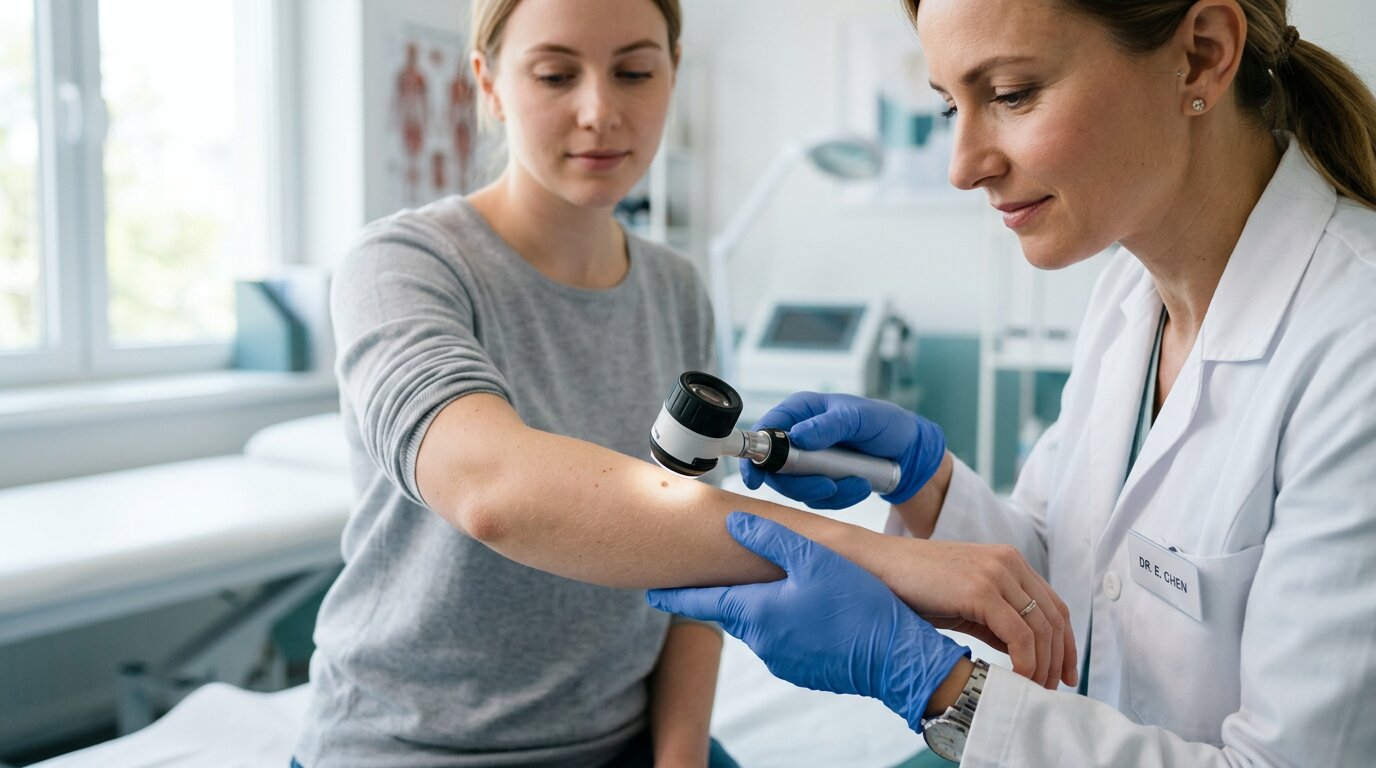
Diagnosis usually begins with a physical examination of the skin. If a suspicious lesion is identified, a biopsy is commonly performed. During a biopsy, a small portion or the entirety of the lesion is removed and examined under a microscope.
If melanoma is confirmed, additional imaging or lymph node evaluation may be needed to determine whether the cancer has spread. This process, called staging, helps guide treatment decisions.
Staging matters because localized cancers are typically easier to treat than cancers that have metastasized to distant organs.
Surgery Remains the Most Common Treatment
For many patients, surgery is the primary and most effective treatment option.
Simple surgical excision involves removing the cancer along with a margin of healthy tissue. This approach is highly successful for many basal cell and squamous cell carcinomas.
Mohs micrographic surgery is another specialized technique frequently used for skin cancers on cosmetically sensitive areas such as the nose, eyelids, lips, or ears. During Mohs surgery, thin layers of tissue are removed and examined immediately under a microscope until no cancer cells remain. This method helps preserve healthy tissue while maximizing cure rates.
For early-stage melanoma, surgical removal may be the only treatment required.
These procedures are often performed on an outpatient basis, allowing many patients to return home the same day.
Radiation Therapy Can Help Certain Patients
Radiation therapy may be recommended when surgery is not ideal or when cancer cells remain after an operation.
This approach uses targeted radiation to destroy cancer cells while limiting damage to nearby tissue. Radiation can be especially useful for older patients, tumors in difficult locations, or cancers that cannot be completely removed surgically.
In advanced cases, radiation may also help relieve symptoms caused by metastatic disease.
Immunotherapy Has Changed Melanoma Treatment
One of the biggest breakthroughs in modern cancer care has been the development of immunotherapy.
Immunotherapy works by helping the immune system recognize and attack cancer cells more effectively. Melanoma responds particularly well to this approach because melanoma tumors often contain many mutations caused by UV damage.
Checkpoint inhibitors such as pembrolizumab (Keytruda), nivolumab, and ipilimumab have transformed survival expectations for many patients with advanced melanoma.
Research now shows that some people with stage 4 melanoma survive for many years after immunotherapy treatment. Clinical studies have reported that more than half of certain advanced melanoma patients treated with combination immunotherapy survived at least 10 years.
Newer therapies are continuing to improve outcomes. Recent trial results involving a personalized cancer vaccine combined with immunotherapy showed substantial reductions in melanoma recurrence risk after surgery.
Targeted Therapy for Specific Mutations
Some melanomas contain genetic mutations that can be targeted with specialized medications.
For example, approximately half of melanomas carry BRAF gene mutations. Drugs designed to block these mutations can slow or shrink tumors significantly in some patients.
Targeted therapy is often combined with other treatments depending on the stage of disease and the patient’s overall condition.
Skin Cancer Treatment Is Becoming More Personalized
Modern cancer care increasingly focuses on personalized treatment planning.
Doctors now consider:
- Tumor genetics
- Cancer stage
- Patient age
- Immune status
- Overall health
- Risk of recurrence
This individualized approach allows treatment plans to be adjusted for both effectiveness and quality of life.
In many hospitals, multidisciplinary teams including dermatologists, oncologists, surgeons, radiologists, and pathologists work together to guide patient care.
Follow-Up Care Is Extremely Important
Even after successful treatment, follow-up remains essential.
Patients who develop one skin cancer have a higher risk of developing another in the future. Regular skin examinations help detect recurrence or new lesions at an earlier stage.
Doctors may recommend:
- Routine dermatology visits
- Self-examinations at home
- Sun protection strategies
- Avoidance of tanning beds
- Daily sunscreen use
- Protective clothing and hats
Long-term monitoring becomes especially important for melanoma survivors because recurrence can occasionally occur years after initial treatment.
Prevention Still Plays a Major Role
Although treatment success rates are improving, prevention remains the best defense against skin cancer.
Ultraviolet radiation from sunlight and tanning devices remains the leading environmental risk factor. Repeated sunburns, especially during childhood, increase lifetime melanoma risk.
Practical prevention strategies include:
- Using broad-spectrum sunscreen
- Seeking shade during peak UV hours
- Wearing protective clothing
- Avoiding indoor tanning
- Monitoring skin changes regularly
These habits can significantly reduce cumulative UV damage over time.
The Outlook for Patients Continues to Improve
The outlook for skin cancer patients today is substantially better than it was even a decade ago. Earlier detection, better public awareness, improved surgical methods, and major advances in immunotherapy and targeted therapy have all contributed to rising survival rates.
While melanoma remains the most dangerous form of skin cancer, even advanced cases are increasingly treatable for some patients. Basal cell and squamous cell carcinomas are often highly curable when managed appropriately.
For patients, one of the most important steps is not delaying evaluation. A suspicious lesion that is assessed early may require only minor treatment, while delayed diagnosis can allow cancer to spread and become more difficult to manage.
Skin cancer can be serious, but modern medicine has made successful treatment far more achievable than many people realize.
